
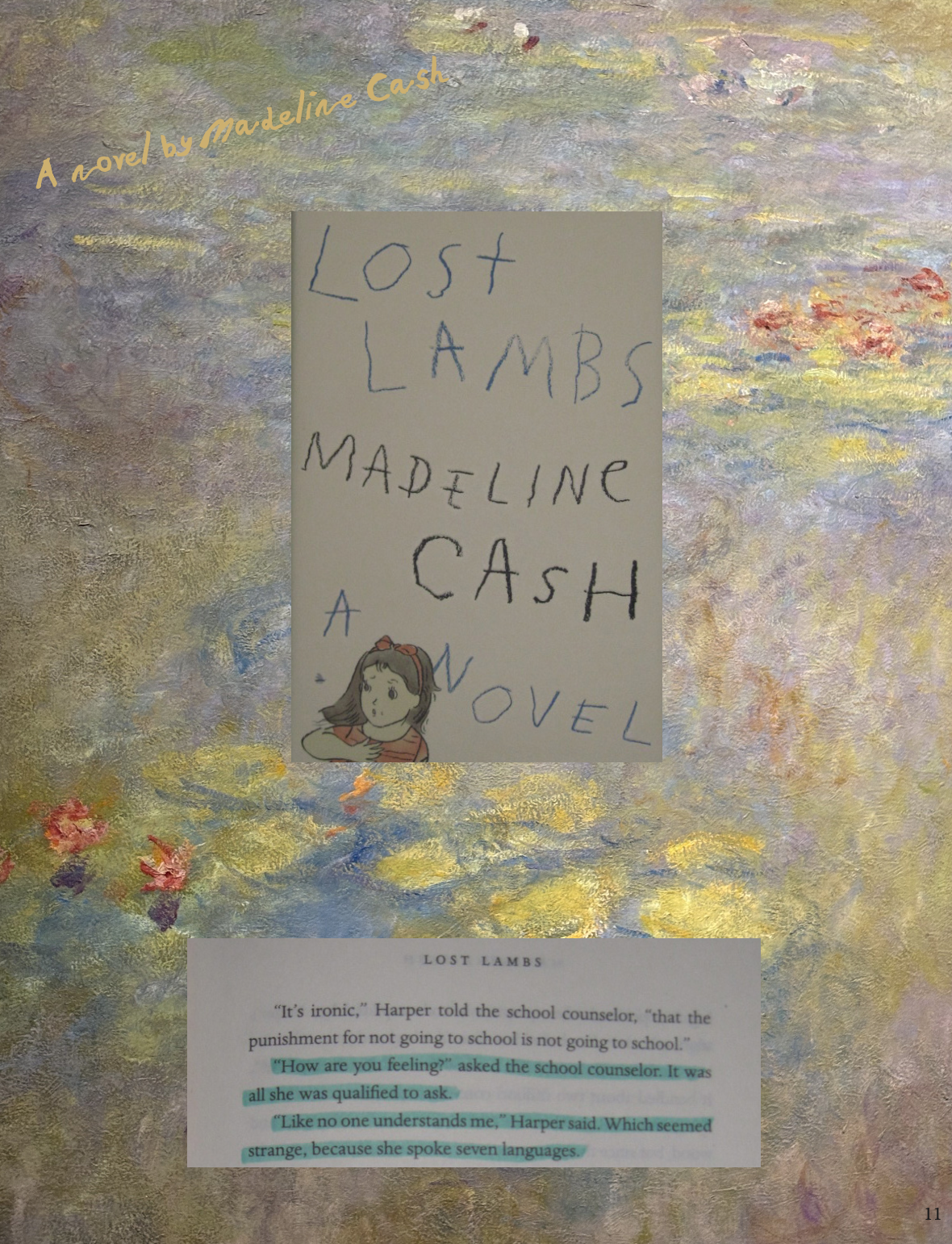
Madeline Cash’s debut novel, Lost Lambs, is one of linguistic experimentation and outlandishly comedic absurdity embedded in each page along with each character. The novel is never just one thing – working as a systems novel that balances witty family dysfunction, ominous conspiratorial planning of the town’s most powerful, and the sweet, complicated tenderness of childhood. The traditional roles of parent and child are disrupted by the nuanced characteristics that work against an archaic system.
The Flynn family is hanging on by a thread; Catherine and Bud are in an unsuccessful open marriage. Bud is sleeping in his van when he’s not residing with Priscilla Winkle, the leader of his Christian support group called “Lost Lambs,” a nod to the biblical reference to lambs wandering away from their flock into danger, and an acknowledgment of the character’s moral disorientation. Catherine is reminiscing on her youth and attempts to have an affair with neighbor Jim Doherty, who encourages her artistic pursuits, but their time is cut short after a tour in Jim’s basement to show Catherine his collection of ceramic vagina sculptures. The three Flynn daughters Abigail, Louise, and Harper are having no easier time with girlhood. Abigail drinks and smokes and has a boyfriend called “War Crime Wes.” Louise has middle child syndrome and prefers to chat online with a terrorist, unbeknownst to her until she’s caught planning an attack herself, and subsequently put on the no-fly list. Harper, perhaps the most interesting character of all, is a child genius whose bored with the mundanity of suburban comfort. As a result, Harper is fluent in seven languages, reading her father’s emails and problem-solving as she eventually uncovers the evil doings carried out by the local billionaire. Yet Harper’s linguistic abilities extend beyond conventional languages; as she comes to understand: “Language barriers were a problem that needed solving. Then Harper had a thought: What if everything was a language? The world opened up. Music, computers, electrical currents, braiding—the lingua franca of hair, the phonics of string—it was all just a matter of communication.” A passage that inspired the name of this magazine and encapsulates Cash’s articulation in storytelling the many ways we can communicate, if only we lend our mind to the idea.
The opening sentence sets the tone for the entirety of the novel both grammatically and metaphorically: “The gnat situation in the church was getting out of hand.” Through graphological deviation, Cash allows the novel's gnat infestation to create its own language, tainting not only the church but the lives of the characters and town itself, with words such as “exterminate” becoming the neologistic “extermignate.” Cash continuously plays with language to reflect the eccentricity of the world she creates, allowing the form of the novel to become as bizarre and unpredictable as its characters. In this sense, Lost Lambs does not simply tell a story about people struggling to understand one another and their world; it makes the reader experience that struggle through its own language. In an interview with Literary Hub, Cash describes the thought behind this phenomenon: “The polyphonic structure: Like I said, I used to write copy for Jack in the Box. My job was coming up with puns. I love word play, jokes, and double entendre.”
Cash creates a world so vivid you would think it already exists not too far away from your own. The entrancing dialogue between multidimensional characters are filled with much depth–even the minute ones. With each dilemma more offbeat than the last, Cash exemplifies the beauty of fiction writing and all the ways a writer communicates an idea with their reader. Cash’s greatest achievement is that nothing in Lost Lambs feels merely decorative; every joke, linguistic disruption, and detail becomes another way of asking how we make sense of the world and one another.
